Is my software legal? Find out how to tell (and why you should care)
Why is legal, genuine software so important?
You’ve probably wondered at some point what’s so important about using legal software. After all, there are various sources for obtaining your desired software for free on the Internet. Is it really worth it to buy licensed software? What’s the worst that could happen if you don’t? And how to tell the difference between illegal and legal software?
I. Risks of using illegal software
Let’s start with evaluating the risks of using non-genuine, illegal software. Here’s a short list of 6 important issues to consider:
Waste of money
It’s one of the most common things to happen – either because you never get what you paid for (software doesn’t work or isn’t even delivered), or because the product you received breaks down after a short while and the seller is nowhere to be found anymore.Security issues
Cracked software is often more vulnerable towards malware, data leaks and privacy breaches, so you risk exposing sensitive information to misuse and abuse by random outsiders, hackers and malevolent agents.Sudden loss of valuable data
When the software stops working unexpectedly due to its compromised nature, you lose valuable data and the backup and recovery options are often limited or non-existent. Whether it’s company assets or private memories, it is not worth the risk.Big fines
A major concern for any sensible business owner. Software piracy is a serious crime and in the event of software audit the fines can reach several times the price of a brand new license, plus you’d have to buy an actual genuine license. Additionally your business image can be tarnished, if word comes out that you were involved in illegal practices. Problems with authority are the last thing that you need in your company.Lack of support and updates
Over time, illegal software gradually becomes outdated and stops working with newer systems, apps and files, so the need for buying a new one arises again. Updates are also essential for security reasons – new cyber threats emerge daily and to prevent them from causing harm to your system and data, it is necessary to keep your software up to date.Lost profits
By using illegal software, you lose the opportunity to get back some of your investment by selling your redundant software. While this may not seem as important as the previous items on this list, it is still a loss for your company to not make optimal use of the assets it possesses.
II. Types of illegal software and how to recognize them
The topic of software legality is vast and complex and there are various licensing frauds and software exploits that you can encounter while purchasing software within the EEA market, but the 2 most common are:
1. Cracked installation
This kind of illegal software is commonly spread, well-known since the 80s and generally used for non-commercial purposes. Cracking is an obvious infringement of the law and as such, scammers wouldn’t even bother trying to sell it to you.
What exactly is cracked software?
Cracked software is a modification of a given software, done without the permission of the original developer.The most common reason for cracking software is to remove, disable or deceive its licensing module, so that the desired program can be used for free. This means that even if the installation is working properly, it is not possible to legalise it just by buying an original license as the software is basically damaged.
To legalise your software, you will need to make a new, clean installation with genuine installation files. Unfortunately, this will still not guarantee the legality of your software as there is one more condition that needs to be met – you can only use original copies of the installation files by the software developer. So make sure you are receiving them from a certified source – the original manufacturer, his authorised partners, or established resellers.
2. Genuine installation with an illegal license
Unlike cracked installations, a genuine installation is the first step to a properly working and licensed software. The trick here is the license itself – there are many ways in which a license can be illegal: it can be counterfeit, it can be illegally acquired, or its properties exploited beyond what is allowed by the law and the manufacturer. The license business is expensive and profitable, and consumers are often not acquainted enough with the licensing rules to be able to tell the difference between fake and genuine, legal and illegal. This is why scammers usually focus their efforts on licensing.
III. Types of illegal licenses
For the purpose of this article, we will be analysing licenses classified in two main groups: digital and physical.
We will use Microsoft products as examples, as the company is among the most popular software developers that get targeted by scammers, but the main principles are similar for many other programs as well.
Digital illegal licenses
Digital licences are software licenses distributed electronically and mainly online – usually via registration on the provider’s platform, or by email. They do not need to have a physical carrier.
The types of illegal digital licenses and their characteristics are listed from the easiest to the hardest to recognize.
Really bad forgeries:
what is it: a sequence of random symbols that looks like an original key without properly following the developer’s logic – even though it may not be immediately obvious, all genuine product keys have a specific structure and logic behind the order and contents of the symbols
is activation possible: no
illegal when: always, it’s a forgery
example of typical fraud: supposed Microsoft product keys that contain any of these characters: 0, O, 1, I, L, 5, S, A, E, U, Z.
Genuine Microsoft keys never use these characters.
KMS activator
what it is: a program that introduces a type of volume channel product key called KMS (Key Management Service – usually used in companies for batch activation of big number of computers) to the system to emulate a KMS server on the chosen device, and force the products to activate against this special server. KMS activation only lasts for approximately 6 months and then requires a new activation.
is activation possible: yes
illegal when: always, it uses a weakness in the technology to deceive the system that it has been activated
Retail licenses
what is it: a genuine Retail product key for a given software
is activation possible: yes
meant for sale to: general consumers, small companies
illegal when:
the license was initially issued outside of the EEA and Switzerland
the seller is registered outside of the EEA and Switzerland
there are no documents for proof of purchase – mainly no invoice (may indicate a stolen license)
OEM licenses
what is it: a genuine OEM product key for a given software
is activation possible: yes (some hardware restrictions apply)
meant for sale to: general consumers, small to medium companies; originally accompanied by hardware
illegal when:
the license was initially issued outside of the EEA and Switzerland
the seller is registered outside of the EEA and Switzerland
there are no documents for proof of purchase – mainly no invoice (may indicate a stolen license)
Volume licenses
what is it: a genuine Volume channel product key for a given software
meant for sale to: medium to large companies, advanced IT systems
is activation possible: yes
illegal when:
the license was initially issued outside of the EEA and Switzerland
the seller is registered outside of the EEA and Switzerland
there are no documents for proof of purchase – mainly no invoice (may indicate a stolen license), no chain of origin (a set of documents showing the previous ownership and original country of origin of the license), no proof of deinstallation
the technical capabilities of the license are exploited beyond the legal agreement (invoice, contract etc);
example of typical exploit: a license bought for the price of one activation sold to multiple customers
MSDN keys
what is it: an MSDN product key is a special product key for testing purposes, generated in Microsoft Visual Studio;
is activation possible: yes
illegal when:
sold as licences – MSDN keys are not licenses at all! They just behave as licences for the purpose of testing software; they can often expire without any warning
used to activate a product for purposes other than the ones defined by the Microsoft Developer Network
example of typical exploit: a scammer can buy Visual Studio with MSDN or Dreamspark subscription, generate many test keys and sell them as genuine licences
Due to the nature of their purpose, it is very difficult for a regular, or even experienced users to check and recognize MSDN keys. This is why MSDN keys are the main tool used for creating counterfeit Microsoft licences – both digital and physical.
Physical illegal licenses
Don’t forget that a license can be completely genuine and still be illegal to use – this is also valid for physical licenses. The rules of legality in regard of purchase and use are similar to the ones for digital licences:
Existence of required valid documents (invoice – always; declaration of deinstallation, chain of origin etc., depending on the type of software);
country of origin (the license has to be issued within EEA and Switzerland);
registration of seller (the seller has to be registered within the EEA and Switzerland);
specifics of the software (the purpose of use has to comply with the rules of the manufacturer and the current laws).
Other illegal practices on the physical license market are counterfeit physical licences and a sale of labels that cannot be used for licensing. That’s why you should always examine the labels carefully – some forgeries can be exposed just by being observant.
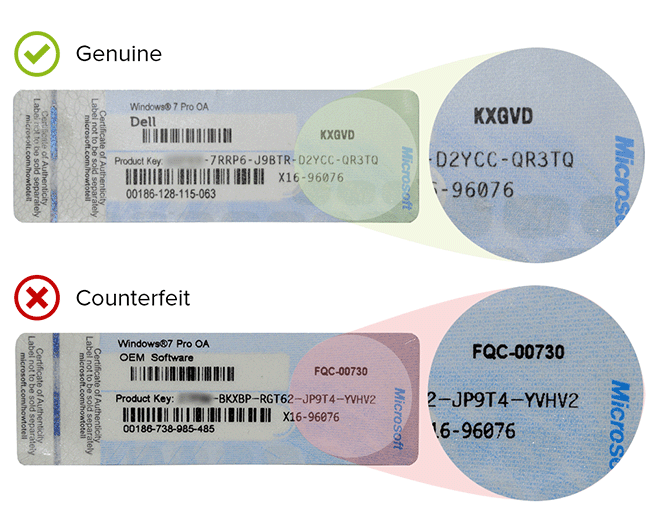
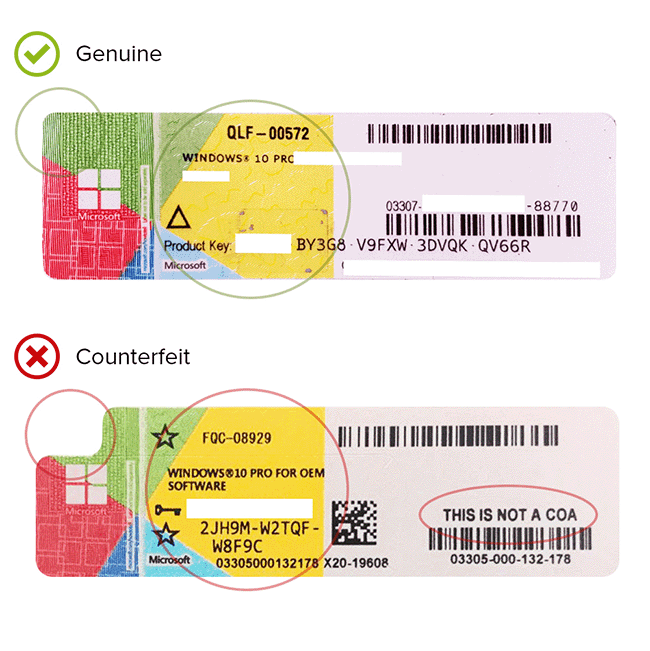
IMPORTANT! As mentioned in the previous part, the most widespread way of making counterfeit Windows CoA is by printing MSDN keys on stickers – this means that the software can be activated and the general user will have no way to find out that he’s a victim of software counterfeiting until the license suddenly stops working. So let’s take a look at some examples of fake Windows CoA stickers below. They will help you determine whether the sticker that you own (or intend to buy) is genuine, or not.
Windows 7
What to look for:
quality of the microtext – sometimes it can be so bad that you can smear it with your finger;
text “OEM Software” – Microsoft usually denotes the distributor (manufacturer) on Windows 7 labels, for example HP, Dell etc.;
holographic security strip – on genuine labels, the holographic security strip passes through the paper of the sticker (similarly to banknotes) and is firmly attached to it, the reflection of the strip also changes colours from light blue to brown; on fake stickers the security strip can be easily removed, and the colours change from blue to grey.
Windows 10
What to look for:
quality of the microtext – genuine stickers are processed by high-quality gravure printing; forgeries have very poor quality;
cut off corner and writing “for OEM Software” – such labels are not produced by manufacturers for EU;
raised elements – on genuine stickers you can feel raised elements by passing your finger on the surface; forgeries are usually just flat paper without molded elements;
writing “THIS IS NOT A COA” in the lower right corner – this writing should not be present for the sticker to be a legal license.
Licences sold with “own” installation media
Last but not least, be aware that the sale of a non-genuine, “own” installation media (for example, original installation file burned on non-original DVD) is in a full breach of copyright and licensing laws, so any company offering this service should be avoided. The only way of selling licenses together with installation media is by selling them with the genuine, unchanged copy of it – for example, a genuine Dell physical license with a genuine Dell installation DVD.
IV. How to avoid buying illegal software?
So how to avoid wasting money, time and peace of mind? There are two main aspects to check before making a purchase: the seller and the product. Below, you can find a list of categorized questions with answers and tips that will help you identify the untrustworthy software license sources.
The Seller
Always start investigating the seller first, as this is where scammers make the most mistakes.
Company details
What to ask:
Is the company registered in EU?
Is the company registered for VAT in EU?
Who is the CEO of the company? Is he or she from EU?
Are the company details easily and freely accessible?
How long has the company been on the market?
These questions will help you identify the credibility and seriousness of the seller.While not a necessary requirement for legality, most serious and reliable sellers of software licenses have an EU-registered company with an EU-registered VAT number. The name of the CEO of the company can sometimes be a small, but important detail, as it can indicate where the person is from – it doesn’t always mean that the company is not legitimate, but since it’s a common trend for scammers from developing countries (mostly from Asia) to register companies in the EEA for the purpose of entering the EU market, double-check everything before ordering.
Additionally (and this applies to any business), the longer a company is on the market, the more credibility it has, so usually legitimate sellers make sure to inform their potential customers about their experience and background.
Legal guarantees
What to ask:
What legal guarantees does the company provide?
What are the terms and conditions? What is the return and exchange policy of products?
The presence of legal guarantees is essential for identifying the reliability and trustworthiness of the seller. Always check the legal guarantees and the terms and conditions policy of the stores you buy from. A lot of scammers don’t even bother to write these important articles and documents properly, as they’re often long and complex, so it will not take as much time as you might think to separate the scammers from the legitimate sellers.
Contact with customers
What to ask:
Is there a contact information on the seller’s website?
Is there a customer support? Live connection (phone or chat)? And if yes, does the company use chatbots, or you can talk to real people?
Being able to easily reach representatives of the company is often a sign that the site is not just a mere facade for a scam, as maintaining a responsive and accessible customer support means additional expenses for the seller and provides more transparency for the customers. It also gives them the opportunity to freely ask questions about anything they are unsure of. A company that sells legal software would have no problem answering any question.
Reviews and ratings
What to ask:
Is the company present on social media (Facebook at the very least)? Since when?
Is the social media company page active?
Are there customer reviews on other platforms than the company’s website?
Nowadays, a social media presence is almost fundamental for any business that takes itself seriously and as such, is an important indicator of trustworthiness. The company’s frequency of activity and ways of engaging with the public have become a valid measure of credibility, as a big part of the interactions are public and stay on both customer and seller’s profile. This means, that a scammer would avoid, or not be able to, maintain an active page for long.
Also, social media together with specialised comparison and shopping platforms, provide a good picture of the reliability of the seller and the product s/he sells thanks to the customer ratings and reviews. So if a seller has a very low review score or no score at all, be wary, as there’s often a valid reason for that.
Additional tips:
Do not buy from a physical person (friends, family, colleagues) – there’s still a risk, even if the person has the best intentions. It’s because they may not be aware of all the legal conditions and requirements.
Do not buy from auction portals (e.g. Ebay). Be wary of marketplaces such as Amazon, as they are often a source of counterfeit or illegal licences and it’s harder to verify the sellers that are present there.
The Product
We’ve already covered a lot about the illegality of licenses in previous sections, but here are a few additional factors to double-check:
Price
What to ask:
Why is the price so much lower than the market average?
A given product can become cheaper as newer versions, editions, or completely new products are released. Usually, the old product would sell less, so manufacturers and sellers often decrease the price to raise interest towards it in the potential buyers. Still, to receive any profit, the seller must sell at a price at least a bit higher than the acquisition, or manufacturing costs. This is why it is highly suspicious when a relatively new, or brand new product is sold at a much lower price than the original manufacturer’s price.
Windows 10 Pro for 15 €? Office 2019 Professional Plus for 100 €? Red flag!
Documentation
What to ask:
What documents are provided upon purchase? (invoice, certificate of legality – either digital or physical)
Besides receiving a license with a genuine product key for activation of your software (certificate of authenticity), you should always receive proof of purchase (an invoice) – otherwise your software is not legally licensed. It’s a common mistake to buy products without proof of purchase, which can often lead to very unpleasant consequences later on.
Product presentation
What to ask:
Are there details about the product?
Are there instructions where to find installation file for the software, how to install and activate it?
Even though the importance of these details (such as type of license, product description, and product box image, hardware requirements, software compatibility etc.) might seem minor at first glance, a well-presented product usually means there’s someone who put effort, creativity and diligence into the e-shop you’re checking out. Support articles demonstrate the willingness to help customers to not only buy the product, but also use it. Scammers don’t put so much effort into their sites usually, as it is costly and time-consuming.
Additional tip: Get well acquainted with the specifics of the product – make sure you can use it for the purpose you are buying it for.
Please note: A license can be genuine and meet the general legality requirements (invoice, country of origin etc.) and still be illegal to use due to restrictions by the manufacturer. One notable example is Microsoft Office Home and Student, which can be used legally only for non-commercial use. This is why it is best to consult a representative of the shop you’re buying from – to make sure the licences you are interested in are suitable for your needs.
Let's fight illegal software together!
The counterfeit software market is dangerous and damaging for both buyers and sellers of software. We at Forscope work actively on reducing the negative influence of scammers in the software license business. We do that by educating our customers about the importance of legal software and by fighting illegal practices with the help of other established software license businesses and the respective authorities.
The topic of software legality is vast and complex and we’ve covered only the main points in this article, but we hope that after reading it, you now have a clearer understanding of this problematic issue.
Having additional questions? Or even doubts about the legality of your license? Our team of experts can examine it and identify a possible fraud. Don’t hesitate to contact us and ask for help with the verification of your license.
Note: This article applies mainly to software distributed and sold according to the rules and legislation of the European Economic Area (EEA) and Switzerland.